Ir al contenido principal

The Silent Way Method

 Hello guys! I´m more than glad to be posting again, this time, sharing my outputs about the Silent Way Method.

To be honest, yesterday when I was reading the PPT, before the class, I was just intrigued about how we would develop this topic because    I had never heard about it and couldn't figure out how it worked. I was curious and today it turned out to be an interesting method.

So, some highlights of today´s class are the following: 

The silent way was founded around the 1970s by the Egyptian, mathematician and educator Caleb Gategno who believed that discovering was better than teaching, the method encourages the use of physical tools like rods, and the teacher´s role was left out to a point of exaggeration, and everything was carried out pretty much silently. We even joked that this method is the adopted child because it has more things in common with the D.M. rather than the GTM.

Some important aspects are:

  • Colors are essential in this method.
  • Sounds as well.
  • Physical objects play an important role.
  • Carried out mostly silently (There is a "critical period" and one may believe that nothing is happening, but actually yes, learning is occurring.)
At the end of the class, teacher Orlando gave us all some rods and we built up some sentences every rod worked as a  sentence component (S-V-C.)

We built up some cool sentences and shapes! :D

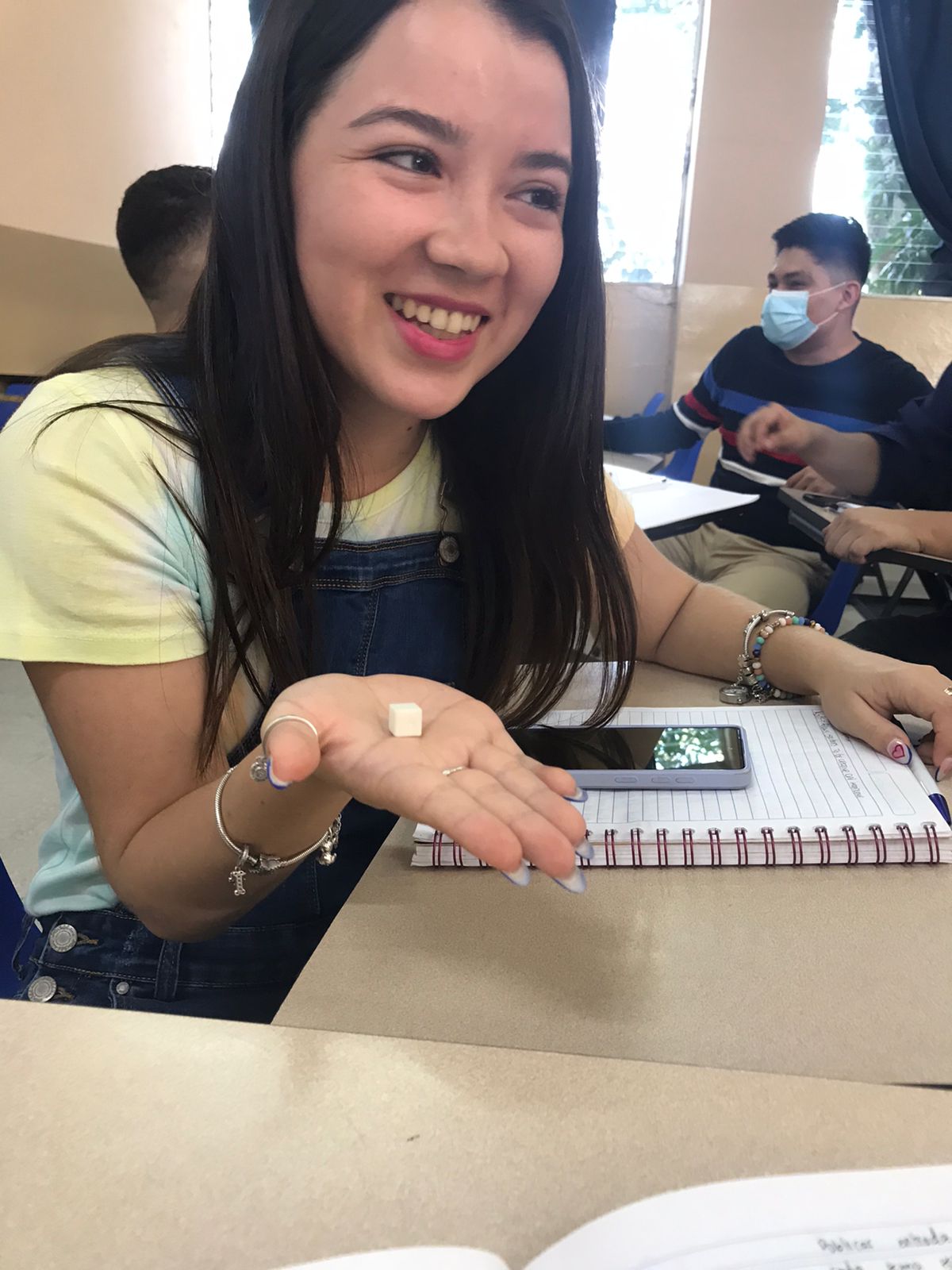
Dani said it was a piece of cheese! That will always remind me of the silent way method!

                                                                                                           Dani was saying that the white rod looked like a piece of cheese, that will always remind me of the Silent Way Method! 馃槅

This was following the S+V+C structure. We came up with sentences in the simple past practicing regular and then irregular verbs.


Comentarios

Entradas populares de este blog

Grammar and Vocabulary Demo Classes

Hello dear teacher and classmates!! Welcome to another weekly entry. Time flies and I can´t believe we are already in a new register! This time, let me start with a fantastic record of our last class. We did some demo classes as a team. It was very funny to see all the course wearing black as if we had planned it!馃槄馃槀 Teacher Orlando divided us into four different groups, I'll introduce mine in a second. And we performed grammar and vocabulary topics as teachers. Let´s get into it and review what each one of us presented to the class! Group 1: Vocabulary - Medical Vocabulary Group number one decided to teach medical vocabulary. I really loved their activities and the topic was especially important since we will most likely be interpreting or translating medical-related things, so I found it very useful.  First of all, they started asking some questions, they showed us some medical stuff and we brainstormed as a class, trying to guess what the right term for the image was. Then, the...

Describing Teachers

 Hi again! Welcome back to a new entry! Today we´re going to talk about teachers, yes! teachers and their amazing job and characteristics. We all have our perceptions about teachers. In my case, before our class, I described teachers as good public speakers,  popular and active or dynamic people in the classroom, and of course very patient and advocate professionals. 馃挮This is true but we can also describe teachers in a more pedagogical way, based on different criteria that might sound a little more technical than the one we used to describe students but, no worries, we´ll go through it in a moment! 馃槉 Teachers are described for their  role in the classroom , as an  organizer ,  performers , their  rapport  with students, as for being  teaching aids , and as  native and non-native  speakers. 1. Teacher´s role in the classroom: s ometimes one might believe that a teacher´s role is to teach a class, but it goes beyond. Teachers in a c...

Body language, coordination, and improvisation

Hello! Welcome to a new entry!   Thanks once again, for taking the time to read my thoughts on a new topic. This time, I will describe all about our body language class, coordination, and improvisation. In this class, we learned a lot of useful tips to improve our body language, we did many exercises, and I loved our very dynamic class.   To start off, we made some space in the classroom and arranged ourselves into two rows, one in front of the other. Then we had to keep eye contact with the person in front of us, trying to be serious. I was in front of Dani, and it was difficult at the beginning but then I could focus better and made it to the end! This kind of exercise helps us be serious even when students might be telling jokes or laughing but we,  teachers, have to be focused on what we are doing and try to look professional and serious when needed. We also tried to keep eye contact with a peer as we walked around, this was harder than I thought! because everyone was...